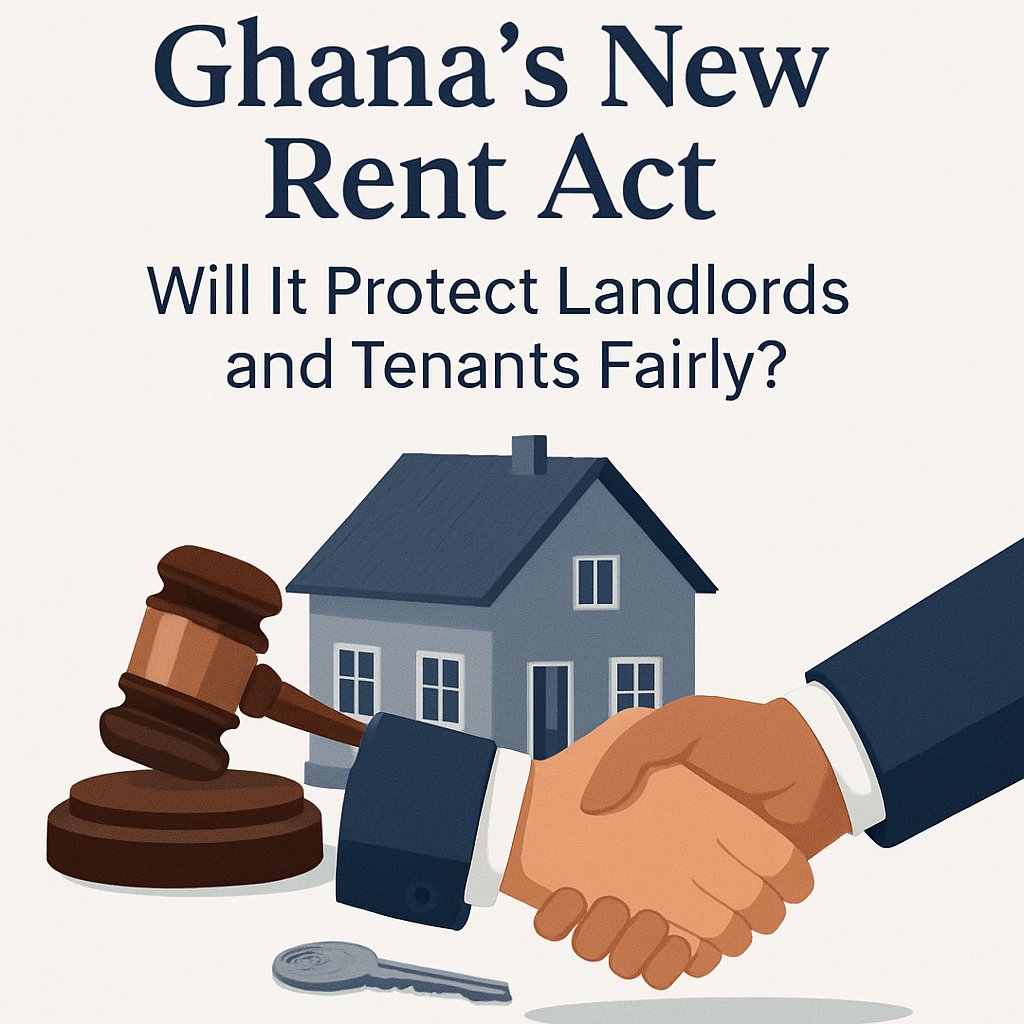
Ghana’s New Rent Act: Will It Protect Landlords and Tenants Fairly?
Emmanuel Preko Boamah
July 7, 2026 • 12 min read
Ghana’s rental housing sector is one of the most important parts of the country’s housing system. Millions of people depend on rented rooms, apartments, hostels, compound houses, shops, and other residential facilities for accommodation. At the same time, thousands of landlords, property owners, hostel owners, and private investors have used their savings, loans, family resources, and years of sacrifice to provide these rental spaces.
However, Ghana’s rent laws have not kept pace with the realities of today’s housing market. The existing Rent Act of 1963 and the Rent Control Law of 1986 were created during a different period, when the cost of land, building materials, labour, utilities, taxes, maintenance, and urban housing demand were very different from what landlords and tenants face today.
As Ghana reviews its rent laws, one major question must be answered clearly: Will the new Rent Act protect landlords and tenants fairly?
A modern rent law should not be designed to punish landlords or expose tenants to exploitation. It should create a balanced system where tenants are protected from abuse, while landlords are also protected from financial loss, property misuse, non-payment of rent, unlawful occupation, and unfair treatment.
Understanding the Need for a New Rent Act
The need for a new rent law is urgent because Ghana’s rental market has changed significantly over the years. Urbanization has increased demand for rental accommodation, especially in cities, university communities, commercial areas, and rapidly developing towns.
Many people now move from rural areas to cities in search of jobs, education, business opportunities, and better living conditions. This has placed serious pressure on available housing. In areas where demand is high and supply is low, rent prices naturally rise.
At the same time, landlords also face rising costs. Land prices have increased, building materials such as cement, iron rods, roofing sheets, tiles, electrical materials, plumbing materials, and finishing items are expensive. Labour costs have also gone up. Many landlords borrow money or use long-term savings to build rental properties, and they expect to recover their investment over time.
Tenants, on the other hand, struggle with high rent advance payments, limited accommodation options, poor-quality rooms, lack of proper tenancy agreements, and sometimes unfair treatment from some landlords or agents.
Because of these realities, Ghana needs a rent law that understands both sides of the rental relationship. The law must protect tenants, but it must also recognize that landlords are investors, property owners, and key contributors to Ghana’s housing supply.
Weaknesses of the Current Rent Laws
The current rent laws have several weaknesses that affect both landlords and tenants.
For landlords, one major challenge is the difficulty in adjusting rent to reflect current market conditions and the rising cost of property ownership. If rent control is applied in a way that ignores inflation, maintenance costs, cost of materials, property taxes, loan interest, and return on investment, landlords may become discouraged from maintaining or expanding rental properties.
Another major weakness is the slow and stressful enforcement process when tenants refuse to pay rent, misuse the property, or refuse to vacate after proper notice. In some cases, landlords spend months or even years trying to recover possession of their own property. During this period, the landlord may continue to suffer financial loss while still paying for repairs, taxes, utility-related issues, loans, and other obligations.
For tenants, the current system also has weaknesses. Many tenants face demands for long rent advance payments, sometimes one year, two years, or more. This creates a heavy financial burden, especially for workers, students, young families, and low-income earners.
Some tenants also suffer from poor living conditions, lack of maintenance, unclear tenancy terms, wrongful eviction threats, verbal agreements without proper documentation, and unlawful actions by some landlords. In some cases, tenants do not know where to seek help or how to enforce their rights.
This shows that the problem is not only about landlords or only about tenants. The real issue is that Ghana needs a modern, clear, enforceable, and fair rent law that protects both parties.
Challenges Faced by Landlords
Landlords face many challenges that are often ignored in public discussions about rent.
First, the cost of building rental property is very high. Before a landlord can rent out even one room, they must acquire land, deal with land documentation, pay for building permits, buy materials, pay workers, connect electricity and water, provide sanitation facilities, and sometimes construct roads, drains, walls, and other supporting infrastructure.
Second, landlords face serious maintenance costs. Buildings require regular repairs, painting, roofing maintenance, plumbing works, electrical works, replacement of damaged fittings, and general upkeep. If tenants do not pay rent on time or if rent levels are not realistic, landlords may struggle to maintain the property properly.
Third, some tenants default on rent payments and refuse to vacate. This creates a difficult situation for landlords, especially when the legal process for recovery of possession is slow. A landlord may own the property but may be unable to use it, rent it to another person, or recover money owed.
Fourth, some tenants damage property beyond normal wear and tear. Broken doors, damaged tiles, destroyed electrical fittings, unpaid utility bills, blocked drainage systems, and careless use of rooms can create additional costs for landlords.
Fifth, landlords sometimes face public criticism as if they are the cause of all rental problems. However, landlords are also affected by inflation, high interest rates, land disputes, construction costs, property taxes, and the general economic situation.
A fair rent law must recognize these challenges and provide proper protection for landlords.
Problems Tenants Face
Tenants also face serious problems in Ghana’s rental system.
One of the biggest challenges is rent advance payment. Many tenants are required to pay large sums before they can move into a room or apartment. This makes it difficult for many people to access decent accommodation, especially young workers, students, traders, and low-income families.
Another problem is the lack of proper tenancy agreements. Some tenants enter into rental arrangements without written agreements, receipts, rent cards, or clear terms. This creates confusion when disputes arise over rent, duration of tenancy, repairs, utility bills, and eviction notices.
Some tenants also face poor living conditions. They may rent rooms with leaking roofs, poor ventilation, bad drainage, unsafe wiring, lack of toilets, overcrowding, or poor sanitation. When landlords refuse to maintain such properties, tenants suffer.
There are also cases where tenants face harassment, unlawful eviction, disconnection of utilities, removal of doors or roofing sheets, locking of rooms, or threats from landlords. These actions can create insecurity and fear for tenants.
A modern rent law must therefore protect tenants from abuse, but it must do so without destroying the confidence of landlords and investors who provide rental housing.
What a Modern Rent Law Should Include
A new Rent Act should create a balanced system. It should not be one-sided. It should protect tenants from exploitation and also protect landlords from unfair losses.
The law should clearly define the rights and responsibilities of both parties. It should explain what landlords can do, what tenants can do, what Rent Control can do, and what the courts must handle.
Rent Advance Regulations
A modern rent law should regulate rent advance payments in a practical way.
Tenants need protection from excessive advance demands. At the same time, the law must recognize that many landlords rely on rent advance to recover part of their investment, renovate their property, settle loans, or fund maintenance.
The law should therefore introduce a realistic system that considers both affordability for tenants and financial sustainability for landlords. For example, rent advance regulation should be linked to proper enforcement of monthly rent payment. If landlords are restricted from taking long advance payments, then there must be a strong and fast system to deal with tenants who refuse to pay monthly rent.
Without proper enforcement, rent advance restrictions alone may create fear among landlords and reduce the supply of rental housing.
Streamlined Eviction and Recovery Process
The eviction and recovery process must be clear, fair, and faster.
Landlords should not be allowed to unlawfully evict tenants, remove doors, disconnect electricity, lock rooms, or use force. At the same time, tenants should not be allowed to abuse the legal process to occupy property without paying rent.
The new law should clearly state the steps for issuing notices, the grounds for recovery of possession, the timelines involved, and the role of Rent Control and the courts. There should be a fast-track process for cases involving rent arrears, property damage, illegal subletting, nuisance, or refusal to vacate after lawful notice.
This will protect tenants from unlawful eviction while also ensuring that landlords can recover their property when the law allows it.
Rent Assessment Mechanism
A modern rent law should include a fair rent assessment mechanism.
Rent should not be based only on emotions, public pressure, or political statements. Rent assessment should consider factors such as location, size of property, condition of the building, facilities provided, market demand, cost of construction, maintenance cost, property value, and reasonable return on investment.
For hostel accommodation, for example, assessment should also consider land cost, number of rooms, number of students per room, security, water supply, electricity, sanitation, internet, furniture, and management cost.
A proper rent assessment system will help determine whether a rent charge is fair, excessive, or justified. This protects tenants from unreasonable rent while also protecting landlords from unfair rent reductions that ignore investment realities.
Protection of Landlord Rights
The new rent law should clearly protect landlord rights.
Landlords should have the right to receive rent on time, inspect their property with proper notice, recover possession through lawful means, increase rent through approved procedures, and be compensated for damage caused by tenants beyond normal wear and tear.
The law should also protect landlords from tenants who refuse to pay rent, abandon rooms with unpaid bills, sublet without permission, use residential property for illegal activities, or damage the property.
If landlord rights are weak, private investment in rental housing may reduce. This can worsen Ghana’s housing shortage and increase rent pressure in the long run.
Tenant Protection Measures
The new law must also protect tenants properly.
Tenants should have the right to safe and decent accommodation, receipts for payments, written tenancy agreements, proper notices, peaceful occupation of the rented premises, and access to legal remedies when landlords act unlawfully.
The law should make it clear that landlords cannot evict tenants by force, lock rooms, seize belongings, remove doors, disconnect utilities unlawfully, or threaten tenants. Disputes must be handled through lawful procedures.
Tenants should also be educated on their responsibilities. They must pay rent on time, take care of the property, avoid nuisance, respect tenancy agreements, report maintenance problems early, and vacate when the tenancy has lawfully ended.
Hostel Accommodation Regulations
Hostel accommodation should receive special attention under the new rent law.
Student hostels are different from ordinary residential rooms. They often involve shared rooms, beds, common washrooms, study areas, security, utilities, furniture, management staff, cleaning services, and sometimes internet access.
The law should therefore provide specific guidelines for hostel accommodation. It should address rent assessment, student safety, room capacity, sanitation, utility charges, maintenance responsibilities, refund policies, booking fees, and the relationship between hostel owners, students, school authorities, and regulators.
This will help prevent disputes between students and hostel owners while ensuring that hostel investment remains attractive to private investors.
Enforcement by Rent Control
Rent Control must be strengthened to enforce the law fairly and professionally.
Rent Control should not appear to support only tenants or only landlords. It must act as a neutral institution that ensures compliance by both sides.
The department should have clear procedures for complaints, inspections, rent assessment, mediation, documentation, receipts, and case referrals. Officers should be trained to handle disputes professionally and avoid public statements or actions that may worsen landlord-tenant relationships.
There should also be accountability within Rent Control. Payments made to the department must be receipted properly, approved fees must be transparent, and landlords and tenants must be treated with fairness and respect.
Recommendations
To create a fair and effective rent law, Ghana should consider the following recommendations:
- The new Rent Act should clearly balance the rights of landlords and tenants.
- Rent advance regulations should be supported by a reliable monthly rent enforcement system.
- Rent assessment should be based on evidence, market realities, property condition, location, and investment cost.
- The eviction and recovery process should be faster, lawful, and fair to both parties.
- Landlords should be protected from rent default, property damage, illegal subletting, and unlawful occupation.
- Tenants should be protected from wrongful eviction, excessive rent advance, poor living conditions, and harassment.
- Hostel accommodation should have special regulations because it operates differently from ordinary residential tenancy.
- Rent Control should be strengthened, modernized, and made more transparent.
- All rent-related payments, fees, and charges should be clearly approved, published, and receipted.
- Public education should be provided for landlords, tenants, students, hostel owners, agents, and Rent Control officers.
- The law should encourage written tenancy agreements, proper receipts, rent records, and clear documentation.
- Government should also focus on increasing housing supply, because rent problems cannot be solved by regulation alone. When housing supply is low and demand is high, rent pressure will continue.
Conclusion
Ghana’s review of its rent laws is a major opportunity to fix long-standing problems in the rental housing sector. However, the new law must be fair, practical, and balanced. A law that protects only tenants while weakening landlords will discourage private investment in housing. A law that protects only landlords while ignoring tenant welfare will expose tenants to exploitation and insecurity. The best rent law is one that recognizes the value of both parties. Tenants need safe, affordable, and secure accommodation. Landlords need respect, legal protection, timely rent payment, and a fair return on their investment. If Ghana wants a healthier rental market, the new Rent Act must promote fairness, responsibility, enforcement, transparency, and housing investment. Only then can the country build a rental system that protects tenants, supports landlords, and improves access to decent accommodation for all.